 Globe Quest
 Human Quest · LearningSign in
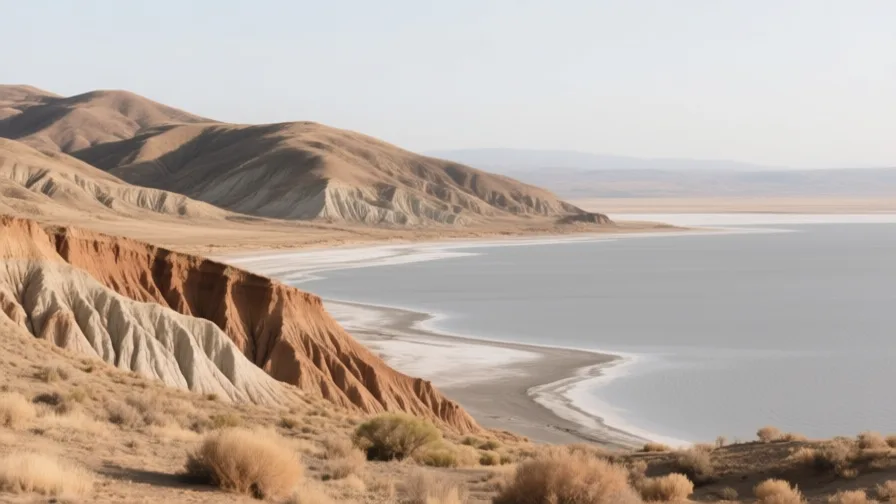 Azerbaijan · AI landscape illustration · Artistic impression
Country · Europe
Azerbaijan
Saved in this browser — no account needed. Sign in later and it comes with you.
Where it is
Azerbaijan covers about 86,600 square kilometres of the South Caucasus, between the Greater Caucasus to the north, the Lesser Caucasus to the west and the Talysh Mountains in the south-east. The Caspian Sea closes it on the east. Eight large rivers run down from the ranges into the central Kura–Aras lowlands, whose flat alluvial plains end in a delta on the sea. The coast lies as much as 28 metres below sea level, while Mount Bazardüzü in the Greater Caucasus reaches 4,466 metres. The mountains block cold northern air, so most plains and foothills are subtropical, and rainfall swings from about 200 mm on the Absheron peninsula to up to 1,600 mm at Lenkeran.
The land and water around it
The Greater Caucasusmountains
The range along the northern border rises to Mount Bazardüzü, at 4,466 metres the highest point. It shields the lowlands from cold northern air, which gives most of the country its subtropical climate.
The Kura–Aras lowlandsplain
Eight large rivers drain into this central flatland, named after the Kura, the longest river in the Caucasus, and its tributary the Aras. The Kura builds a delta and enters the Caspian just below the confluence. The Mingachevir Reservoir, the country’s largest water body, was made by damming the Kura for power and irrigation.
The Caspian shore and Absheronsea
The coastline runs for about 800 kilometres, with the dry Absheron peninsula and Gobustan, whose mud volcanoes and rock carvings lie near Baku. The Caspian rose 1.5 metres between 1978 and 1993, reversing a long dry trend.
Its history, in short
The territory was first the home of Caucasian Albania, whose language was probably an ancestor of today’s Udi, and then of a succession of Persian empires. After the Arab conquest, and then the arrival of Oghuz Turkic migrants from the eleventh century, the population turned Turkic-speaking, and Persian speech gradually faded. After the death of Nader Shah in 1747 a series of khanates arose, and two wars between Russia and Persia, fought from 1804 to 1813 and from 1826 to 1828, ended with Qajar Iran giving up the Caucasus, with the border along the Aras fixed by the treaties of Gulistan and Turkmenchay. An Azerbaijani national identity formed by the late nineteenth century. The Azerbaijan Democratic Republic, proclaimed in 1918, was the first secular democratic republic in a Muslim-majority state, and the Red Army ended it in April 1920. The republic supplied much of the Soviet Union’s oil and gas in the Second World War. Independence came in 1991, followed at once by war with Armenia over Nagorno-Karabakh. Heydar Aliyev took power in 1993 and his son Ilham succeeded him in 2003. The old conflict was reopened in 2020 and ended with the offensive of 2023.
Timeline
Dates are shown on a timeline rather than as changing shapes on the map. The globe draws modern boundaries only, and tinting a modern outline to stand for a historical one would state something we cannot source.
Classical world
c. 550 BCE
Absorbed into the Achaemenid Empire
The Medes, who dominated the lands south of the Aras, are integrated into the Achaemenid Empire. Zoroastrianism spreads, and the name Azerbaijan later derives from Atropates, a satrap of Media.
Approximate dateWikipedia252
Caucasian Albania becomes a Sasanian vassal
The kingdom keeps its monarchy but loses real power to a Sasanian military governor. King Urnayr adopts Christianity as the state religion in the fourth century.
Post-classical world
early 11th century
Oghuz Turks arrive
Migrating Oghuz Turks from Central Asia gradually take the territory. Over the centuries the native population mixes with them, and a Turkic dialect, ancestor of Azerbaijani, replaces Persian.
Industrial & imperial
1813 and 1828
Treaties of Gulistan and Turkmenchay
After the Russo-Persian wars, Qajar Iran cedes the khanates of the Caucasus to the Russian Empire, and the Aras becomes the border.
Well attestedWikipedia28 May 1918
Azerbaijan Democratic Republic
The Musavat party proclaims independence after the collapse of the Russian Empire. The name Azerbaijan had until then meant the neighbouring region of north-western Iran. The Allies recognised the republic in January 1920.
28 April 1920
Soviet conquest
The Red Army invades and a Soviet government is set up. As many as 20,000 die resisting what was in effect a Russian reconquest.
Well attestedWikipedia
Contemporary
1991
Independence
Independence is proclaimed on 30 August, and the Supreme Council adopts a declaration of independence on 18 October, which a referendum affirms in December. The First Nagorno-Karabakh War begins by the end of the year.
2020–2023
Return of Karabakh
After the Second Nagorno-Karabakh War in 2020, seven districts and part of Nagorno-Karabakh return to Azerbaijani control, and an offensive in 2023 ends the Republic of Artsakh and expels the region’s Armenians.
Azerbaijan holds that it restored sovereignty over internationally recognised Azerbaijani territory. Armenia and the Karabakh Armenians describe an expulsion; the region was internationally recognised as part of Azerbaijan, but was populated mainly by Armenians.
Places that carry meaning
Bakuancient to today
The capital and largest city, with the best harbour on the Caspian and the centre of the oil industry. Its walled old city holds the Maiden Tower and the Palace of the Shirvanshahs.
GobustanMesolithic onward
Caves and rock carvings near Baku depict hunting, fishing, work and dancing, and a carving by Legio XII Fulminata, believed to be the easternmost Roman inscription known, survives to the south-west of the city.
Azykh CaveLower Palaeolithic
One of the oldest sites of archaic human habitation in Eurasia, with remains at least 700,000 years old in its lowest layers. A 300,000-year-old jawbone was found there in 1968.
Languages here
Places are usually multilingual. This lists what is actually spoken, not one language per border.
AzerbaijaniTurkic family
The official language and mother tongue of about 96 per cent.
A Turkic language that replaced Persian as the main speech after centuries of Turkic settlement.
RussianSlavic family
A legacy of Russian and Soviet rule.
The mother tongue of 0.8 per cent of the population, and still used in public life.
Lezgin, Talysh, Avar and other minority languages
Spoken natively by small communities.
About a dozen minority languages are spoken natively, among them Avar, Lezgin, Talysh, Tat, Udi, Georgian and Juhuri. Lezgins make up 1.7 per cent and Talysh 0.9 per cent of the population, and several of these languages are tiny and shrinking.
Learn the language here
Check yourself
What is the origin of the name Azerbaijan?
It derives from Atropates, a Persian satrap of Media
The name goes back to Atropates, and in 1918 the Musavat government applied it to the new republic although it had been the name of a region in north-western Iran.
What was the Azerbaijan Democratic Republic of 1918?
The first secular democratic republic in a Muslim-majority state
It lasted until April 1920, when the Red Army invaded, but its flag was restored in 1990 as independence approached.
Worth arguing about
- The name Azerbaijan was applied to a Caucasian republic in 1918 even though it had referred to a region in Iran. What does it mean for a country to take a name its neighbour already uses?
- Nagorno-Karabakh was internationally recognised as Azerbaijani, yet its population was Armenian. How should the claims of territory and of people be weighed?
What we have not established
These are open questions, listed rather than filled in. We would rather show a gap than a plausible guess.
How many Muslims in Azerbaijan are Shia and how many Sunni?
Estimates put Shia at 55 to 65 per cent and Sunni at 45 to 55 per cent. The ranges overlap, so the true balance is not known, and conversions to Sunni Islam are said to be rising.
Sources
- Wikipedia · AzerbaijanWikipedia · encyclopedia · checked 2026-11-24
- Wikipedia · History of AzerbaijanWikipedia · encyclopedia · checked 2026-11-24
- Wikipedia · Geography of AzerbaijanWikipedia · encyclopedia · checked 2026-11-24
Reviewed by Globe Quest editorial on 2026-11-24. Drafted with AI assistance and checked against the sources above before publication.