 Globe Quest
 Human Quest · LearningSign in
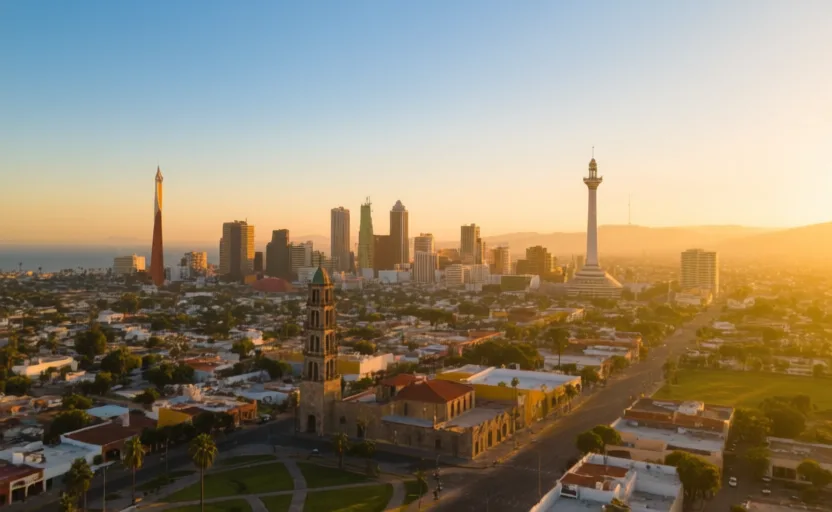 Tijuana · AI city illustration · Artistic impression
City · Latin America
Tijuana
Saved in this browser — no account needed. Sign in later and it comes with you.
Where it is
Tijuana is the westernmost city in Mexico, packed into a valley and the hills and canyons around it, immediately south of the line that separates Baja California from California. Its northern neighbours are San Diego’s San Ysidro and Otay Mesa districts, and the border between the two cities runs for about 24 kilometres. The Tijuana River crosses the central valley in a concrete channel. The climate is hot semi-arid, with roughly 231 millimetres of rain a year, nearly all of it between November and March, and a cold offshore current keeps the coast noticeably cooler than the inland districts in summer.
The land and water around it
The Tijuana River valleyvalley
The central district, including the Zona Río business area, lies on the floor of this valley, where the river has been forced into a channel. A flood in 1916 destroyed the first racetrack just south of the border gate, which is why the later Agua Caliente track was placed on higher ground across the river.
Hills and canyonshills
Housing climbed the surrounding hills as the population grew, wiping out many of the seasonal streams. Because rents are high, many families built without permits on unused slopes, and a landslide in April 2025 brought down a three-storey apartment block, after which officials began watching more than ten large buildings.
A Mediterranean-edged desert coastclimate
The city sits where a hot semi-arid climate meets the winter-rain pattern found just to the north, east and southeast. Storms arrive as fronts off the Pacific between November and March, and the coastal strip is cooler than the districts a few kilometres inland.
Its history, in short
The valley was Kumeyaay country long before Europeans mapped its coast, first from Cabrillo’s ship in 1542 and then by Vizcaíno in 1602. The place became a settlement only in the nineteenth century, when a governor granted Santiago Argüello a cattle ranch of about 100 square kilometres in 1829. The war with the United States then moved the frontier to the edge of the ranch. Mexico lost Alta California in 1848, and Tijuana found itself on a new international line, serving ranchers, prospectors in transit and families who chose to stay in Mexico. The city dates its founding to an agreement of 11 July 1889 between Argüello’s heirs and Agustín Olvera. From the start it sold itself to Californians: the exposition crowds of 1915, Prohibition-era drinking and gambling, and the Agua Caliente resort of 1928 all depended on the border. The ban on casinos in 1935 ended that chapter. Later decades brought migrants from the rest of Mexico, hundreds of twin-plant factories and a tighter line after 2001, with long waits to cross north.
Timeline
Dates are shown on a timeline rather than as changing shapes on the map. The globe draws modern boundaries only, and tinting a modern outline to stand for a historical one would state something we cannot source.
Early modern & oceanic
1542
Cabrillo sails past
Juan Rodríguez Cabrillo tours the coast of the Californias, the first European record of the area that later became the Valley of Tijuana. Sebastián Vizcaíno maps it in 1602.
Well attestedWikipedia
Industrial & imperial
1829
Rancho Tía Juana
Governor José María de Echeandía grants Santiago Argüello a large cattle ranch of about 100 square kilometres. The name of the ranch becomes the name of the city.
Well attestedWikipedia1848
The border arrives
After the Mexican–American War, Mexico loses Alta California and the dividing line between the Californias moves north to sit between San Diego and Tijuana. Some Spanish-speaking families move south to stay inside Mexico.
Well attestedWikipedia11 July 1889
Founding of the city
Argüello’s descendants and Agustín Olvera sign an agreement to develop an urban settlement, the date the city treats as its founding.
Well attestedWikipedia1911
Revolutionaries take the town
Fighters loyal to Ricardo Flores Magón hold Tijuana for a little over a month during the Mexican Revolution. Federal troops and local defenders drive them out, and they are arrested after crossing north.
Well attestedWikipedia1928
The Agua Caliente resort
A hotel, spa, racetrack, golf course, private airfield and casino open, drawing film stars and gangsters from across the border during Prohibition. The racetrack follows in 1929.
Well attestedWikipedia1935
Casinos banned
President Cárdenas decrees an end to gambling in Baja California. The resort fails, and in 1939 the site is reopened as a school.
Well attestedWikipedia
Places that carry meaning
Avenida Revolución1920s onward
The tourist strip that grew up with Prohibition-era bars and casinos. It remains the best-known street in the old centre, though people who live in the city often prefer the clubs of the Zona Río.
Agua Caliente remains1928–1935
Little of the resort survives. The pool and a chimney once used as an incinerator, now called the minarete, stand on school grounds, and a replica of the entrance bell tower marks the start of Boulevard Agua Caliente.
Tijuana Cultural Center (CECUT)1982
Opened to present the city as a place for culture and not only shopping and nightlife. It houses the Museum of the Californias, an OMNIMAX cinema and exhibition halls.
Languages here
Places are usually multilingual. This lists what is actually spoken, not one language per border.
SpanishRomance family
The everyday language of the city and of the migrants who built it.
Most newcomers come from elsewhere in Mexico, especially Sinaloa, Michoacán, Jalisco, Oaxaca and Mexico City, so the city’s Spanish carries accents from across the country.
EnglishGermanic family
The cross-border language of trade, tourism and the American residents.
A large and growing community of Americans, mostly from Southern California, lives in the city, and American English is widely understood in Mexico’s border states.
ChineseSino-Tibetan family
Spoken by one of the largest Asian communities in Mexico.
Chinese immigrants make up most of the city’s Asian population. Cubans, Guatemalans and, more recently, Haitians have also settled in the city.
KumeyaayYuman family
The language of the valley’s first inhabitants.
The Kumeyaay hunter-gatherers lived in the region before the ranch era, and the most widely accepted reading of the city’s name traces it to a Kumeyaay word for “by the sea”.
Learn the language here
- 1Understand which languages are spoken hereTijuana is multilingual. Start with which languages are used, by whom, and for what — the phrase list only covers one of them.Written by Globe Quest
- 2Learn 12 phrasesCurated everyday phrases for Tijuana, with audio and a written form.Written by Globe Quest
- 3Say them out loudSpeaking practice with pronunciation feedback, one phrase at a time.Globe Quest material, your own additions
- 4Come back to themSpaced review, so what you learned this week is still there next month.Written by Globe Quest
Check yourself
What event is treated as the founding of Tijuana as a city?
An 1889 agreement between Argüello’s heirs and Agustín Olvera
The ranch of 1829 gave the place its name, but the city counts its beginning from the agreement of 11 July 1889 to lay out an urban settlement.
Why did Tijuana end up on an international border?
Mexico lost Alta California in 1848, which moved the dividing line north of the town
The war of 1846 to 1848 left the old line between the Californias north of Tijuana, turning a ranching valley into a frontier town.
Worth arguing about
- Tijuana grew by selling the things that were forbidden or expensive across the line, from Prohibition-era drinking to medical tourism and factory labour. How much of a city’s character is set by what its neighbour restricts?
- Hillside housing built without permits is both a response to unaffordable rents and a real danger in heavy rain. Who should carry the cost of making those slopes safe?
What we have not established
These are open questions, listed rather than filled in. We would rather show a gap than a plausible guess.
How many people live in Tijuana?
The 2020 count for the city is 1,810,645, while a 2024 estimate puts the figure at 2,297,000. The gap reflects different boundaries and the pace of migration, so the entry avoids giving a single current total.
Where does the name Tijuana come from?
Historians favour a Kumeyaay origin, from a settlement called Tihuan or Tiwan, but the meaning is disputed. A popular story about an innkeeper called Aunt Jane has no record behind it.
Sources
- Wikipedia · TijuanaWikipedia · encyclopedia · checked 2026-11-24
- Wikipedia · MexicoWikipedia · encyclopedia · checked 2026-11-24
Reviewed by Globe Quest editorial on 2026-11-24. Drafted with AI assistance and checked against the sources above before publication.