 Globe Quest
 Human Quest · LearningSign in
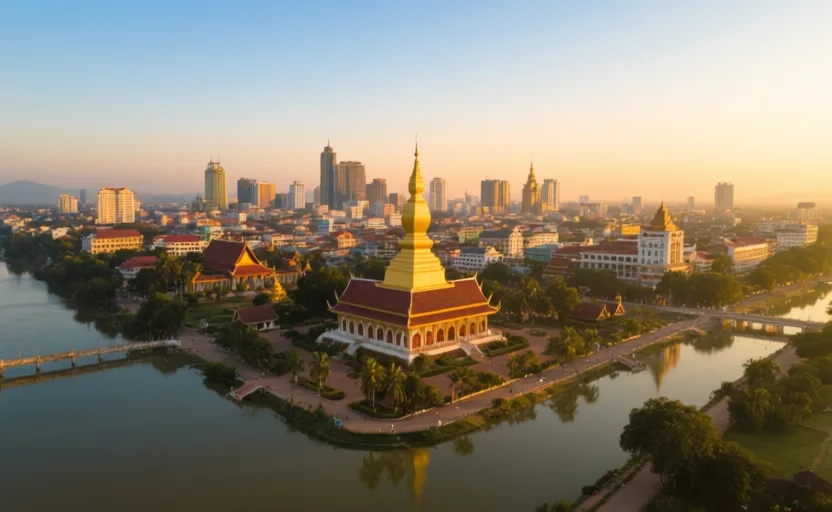 Vientiane · AI city illustration · Artistic impression
City · Southeast Asia
Vientiane
Saved in this browser — no account needed. Sign in later and it comes with you.
Where it is
Vientiane is the capital of a landlocked country, and most of its surroundings are mountains. It is the exception: it stands on the left bank of the Mekong on one of the few broad plains in Laos, with Thailand just across the river, which forms much of the western border. The river here is a frontier between two states but was once a road within a single region. The climate is tropical, with a rainy season from May to October, about 1,700 millimetres of rain a year, a cool dry spell from November to February and a hot one in March and April.
The land and water around it
The Mekong forms much of Laos’s western border with Thailand, and boats can use it along the whole length of the country for most of the year. The river was a border only once the French set it as one: before the 20th century, kingdoms and principalities held land on both banks, and Thai control in the 19th century reached the left bank.
The Vientiane plainplain
Across most of Laos the land is steep and above 500 metres, and the plain around Vientiane is one of the few broad areas that is not, together with the Plain of Jars. Together with the alluvial terraces of the Mekong, such lowlands cover about 20 per cent of the country, which is part of the reason a capital grew here.
Its history, in short
Vientiane appears in Vietnamese inscriptions of the 12th century, which record raids by a vassal of the Khmer called Văn Đan, and Mon city-states had been founded along the middle Mekong in the 8th century. With the creation of the kingdom of Lan Xang by Fa Ngum in the 14th century, Vientiane became an administrative town. King Photisarath moved the court here from Luang Prabang in 1520 against the threat of Burma, and Setthathirath made it the formal capital in 1563 and soon afterwards built the great stupa of That Luang. After Lan Xang split in 1707, Vientiane was a rival kingdom, then a Siamese vassal. Its king Anouvong rebelled in 1826 and the city was ransacked. The French made Vientiane the capital of their Laos in the late 19th century, and by 1943 Vietnamese settlers, brought in under colonial labour policy, made up 53 per cent of its people. After a civil war the Pathet Lao took the city in 1975, the monarchy went into exile and the Lao People’s Democratic Republic was declared.
Timeline
Dates are shown on a timeline rather than as changing shapes on the map. The globe draws modern boundaries only, and tinting a modern outline to stand for a historical one would state something we cannot source.
Post-classical world
8th century
Mon city-states on the middle Mekong
The Mon create walled towns in the region, among them Chantaburi, the name given to Vientiane in this period. The towns are culturally close and spread Theravada Buddhism from Sri Lanka.
Approximate dateWikipedia1135
Vientiane in a Vietnamese inscription
A Vietnamese inscription dated 1159 records that in 1135 Văn Đan, taken to be Vientiane and a vassal of the Khmer, raided Nghe An and was driven back.
Approximate dateWikipedia1354 (or 1357)
Lan Xang
The kingdom of Lan Xang, “a million elephants”, is founded by Fa Ngum. Vientiane becomes an administrative city. The year of founding is given as 1354 in one account and 1357 in another.
Early modern & oceanic
1563
Formal capital
Setthathirath establishes Vientiane as the capital of Lan Xang to avoid Burmese invasion, after Photisarath had moved the court there from Luang Prabang in 1520. That Luang is dated to 1566.
Industrial & imperial
1826
Anouvong’s rebellion
Anouvong, installed as a vassal king of Vientiane by the Siamese, rises against Siam under Vietnamese pressure. The rebellion fails, Vientiane is ransacked, and Anouvong dies in captivity in Bangkok.
Well attestedWikipedia1893 onward
French capital of Laos
Under French rule Vientiane again becomes the capital after Sisavang Vong rules a unified Laos from Luang Prabang. French labour policy brings Vietnamese migrants, and by 1943 they are 53 per cent of the city.
Contemporary
1960
Capital seized twice
In August, Kong Le seizes the capital and installs Souvanna Phouma as prime minister. In December, Phoumi Nosavan retakes it, overthrows Souvanna Phouma and installs Boun Oum.
Well attestedWikipediaAugust–December 1975
Pathet Lao take the city
As Pathet Lao troops approach, the Americans begin evacuating, and a contingent of 50 Pathet Lao women symbolically enters the city on 23 August. The civil war is declared over on 2 December when the monarchy goes into exile.
Well attestedWikipedia
Places that carry meaning
Pha That Luang1566, restored 1953
The golden stupa, 45 metres tall, is a national monument and is believed to hold a relic of the Buddha. King Setthathirath built it in 1566, as the new capital was being established.
Wat Si Muang1563
A temple raised over the remains of an older Hindu shrine of the Khmer, some of which are visible behind the ordination hall. A local legend says the spirit of a girl, Nang Si, who leapt to her death as the pillar was lowered, guards it.
Local Lao tradition of the temple
Patuxai1957–1968
A memorial monument that became a landmark of the city. The nearby Haw Phra Kaew, a former temple, once housed the Emerald Buddha and is now a museum.
Languages here
Places are usually multilingual. This lists what is actually spoken, not one language per border.
LaoTai-Kadai family
The official language, written in an alphabet derived from the Khmer script.
The Lao alphabet developed in the 13th or 14th century from Khmer script. Ethnic Lao, the main lowland people, are a majority of the country’s population.
FrenchRomance family
A legacy language of government and commerce.
French was the colonial administrative language, and Laos is a member of La Francophonie, which estimated 173,800 French speakers in 2010.
English, Khmu and Hmong
A rising foreign language and two minority languages of the highlands.
English, the language of ASEAN, is increasingly studied. Khmu, an Austroasiatic language, and Hmong, from the Hmong-Mien family, are spoken mainly in the midlands and highlands rather than the capital.
Learn the language here
- 1Understand which languages are spoken hereVientiane is multilingual. Start with which languages are used, by whom, and for what — the phrase list only covers one of them.Written by Globe Quest
- 2Learn 11 phrasesCurated everyday phrases for Vientiane, with audio and a written form.Written by Globe Quest
- 3Say them out loudSpeaking practice with pronunciation feedback, one phrase at a time.Globe Quest material, your own additions
- 4Come back to themSpaced review, so what you learned this week is still there next month.Written by Globe Quest
Check yourself
Who officially made Vientiane the capital of Lan Xang?
Setthathirath
Setthathirath formalised Vientiane as capital in 1563 to stay out of reach of Burmese invasion, and then built the stupa of That Luang.
By 1943, what share of Vientiane’s population was Vietnamese?
53 per cent
French colonial policy encouraged Vietnamese migration to fill labour needs, which made them the majority in several Lao towns, 53 per cent in Vientiane.
Worth arguing about
- The Mekong divides Vientiane from Thailand, yet once tied kingdoms on both banks together. When does a river work better as a border, and when as a road?
- French colonial planners moved settlers into Laos and Vientiane became majority Vietnamese. How should a small country think about the way its capital was shaped by outsiders’ plans?
What we have not established
These are open questions, listed rather than filled in. We would rather show a gap than a plausible guess.
How many people live in Vientiane?
The 2023 census puts the city at about 840,000, while estimates for the same year reach about 1 million. The gap probably reflects where the boundary of the capital is drawn, and no single count is used here.
Sources
- Wikipedia · VientianeWikipedia · encyclopedia · checked 2026-11-24
- Wikipedia · LaosWikipedia · encyclopedia · checked 2026-11-24
- Wikipedia · History of LaosWikipedia · encyclopedia · checked 2026-11-24
- Wikipedia · Geography of LaosWikipedia · encyclopedia · checked 2026-11-24
Reviewed by Globe Quest editorial on 2026-11-24. Drafted with AI assistance and checked against the sources above before publication.