 Globe Quest
 Human Quest · LearningSign in
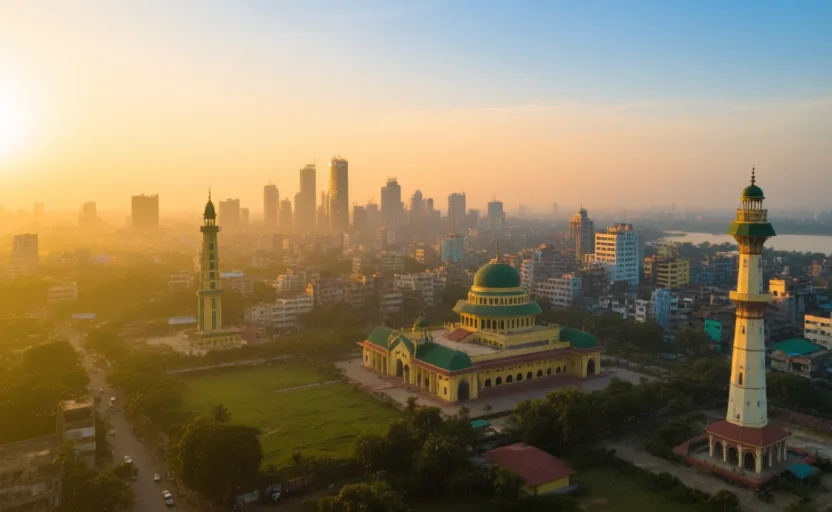 Gazipur · AI city illustration · Artistic impression
City · South Asia
Gazipur
Saved in this browser — no account needed. Sign in later and it comes with you.
Where it is
Gazipur is the northern edge of Greater Dhaka, about 25 kilometres up the road from the capital, and it has become the place where the metropolis keeps its factories. To the south it meets Dhaka North City Corporation and the Savar area, and around it are the upazilas of Kaliganj, Sreepur and Kaliakair. It lies inside a country where almost 80 per cent of the land is low alluvial plain made by the Ganges, Brahmaputra and Meghna, and where the monsoon decides the rhythm of the year. The city is large in area, at about 330 square kilometres, because it was drawn to include towns and villages that had been separate.
The land and water around it
The Dhaka corridorplain
The city lies 25 kilometres north of the capital and forms part of Greater Dhaka. It is a major industrial city, and its southern edge touches Dhaka North City Corporation and the Savar area.
The Bangladesh Plaindelta
About 80 per cent of the country is fertile alluvial lowland, most of it less than ten metres above sea level, made by the Ganges, Brahmaputra and Meghna. Floods in the monsoon are part of normal life for the whole country.
Its history, in short
Little is recorded about Gazipur before the twenty-first century, and what the sources do show is the speed of recent change. In 2011 the area that would become the city held about 1.6 million people. In 2013 the municipalities of Gazipur and Tongi, and rural areas around them, were merged into the Gazipur City Corporation, the youngest and largest of the country’s city corporations. By 2022 it had 2.68 million people, the third-largest city in Bangladesh. It has come to hold some 75 per cent of the country’s garment industries, in a nation where garments are one of the three main sources of foreign exchange, alongside shrimp and migrants’ remittances. The region around it, like the rest of Bengal, passed from the Sultanate and the Mughals to the East India Company and then to East Bengal in 1947, before independence in 1971.
Timeline
Dates are shown on a timeline rather than as changing shapes on the map. The globe draws modern boundaries only, and tinting a modern outline to stand for a historical one would state something we cannot source.
Contemporary
1947
East Bengal
The partition of Bengal makes Dhaka’s hinterland the eastern, most populous wing of Pakistan. Gazipur is part of this region.
Well attestedWikipedia1971
Independence
Bangladesh becomes a sovereign state on 16 December 1971.
Well attestedWikipedia2011
1.6 million people
The census counts 1,626,077 people in 398,164 households in the area that would become the city corporation, and a literacy rate of 67.39 per cent.
Well attestedWikipedia2013
Gazipur City Corporation
The municipalities of Gazipur and Tongi are merged with rural areas, among them Bashan, Gachha, Kashimpur, Kayaltia, Konabari and Pubail, into a new city corporation of 329.53 square kilometres, with 57 wards.
Well attestedWikipedia2022
2.7 million people
The census counts 2,677,715 people in 836,875 households, with 112.61 men for every 100 women, a literacy rate of 83.57 per cent and 15 per cent of the population under ten. This makes it the third-most populous city in the country.
Well attestedWikipedia
Places that carry meaning
Gazipur City CorporationFrom 2013
A government body created from several municipalities and rural unions, divided into 57 wards and 131 mahallas. It is the largest in area of the country’s city corporations.
TongiMerged 2013
A municipality that was combined with Gazipur’s in the 2013 merger. It shows how the new city is a union of places that were once separate.
The garment beltPresent
About 75 per cent of Bangladesh’s garment industries are said to be situated in Gazipur, and it is the centre of the country’s textile industry.
Languages here
Places are usually multilingual. This lists what is actually spoken, not one language per border.
Bengali (Bangla)Indo-European family
The official and national language, spoken by almost everyone.
Standard Bengali is understood everywhere, and the general Eastern Bengali dialect is spoken in Greater Dhaka besides it. A law of 1987 requires Bengali in all government affairs except foreign relations.
EnglishGermanic family
A widely understood second language in law and education.
It is a compulsory subject in schools, and many people in business can read and write it more easily than they can speak it.
Learn the language here
- 1Understand which languages are spoken hereGazipur is multilingual. Start with which languages are used, by whom, and for what — the phrase list only covers one of them.Written by Globe Quest
- 2Learn 12 phrasesCurated everyday phrases for Gazipur, with audio and a written form.Written by Globe Quest
- 3Say them out loudSpeaking practice with pronunciation feedback, one phrase at a time.Globe Quest material, your own additions
- 4Come back to themSpaced review, so what you learned this week is still there next month.Written by Globe Quest
Check yourself
How was Gazipur City Corporation created in 2013?
By merging the municipalities of Gazipur and Tongi with rural areas
The merger made the newest and largest city corporation in the country, covering 329.53 square kilometres.
What industry is Gazipur known for?
Garments and textiles
About 75 per cent of Bangladesh’s garment industries are said to be in Gazipur, and that concentration is why it counts as a major industrial city on the capital’s northern side.
Worth arguing about
- A city created on paper in 2013 by merging towns and villages now has 2.7 million people. What holds such a city together?
- Garment factories draw workers from across the country to the edge of Dhaka. What does a city owe the people whose work it exists for?
What we have not established
These are open questions, listed rather than filled in. We would rather show a gap than a plausible guess.
How old is Gazipur, and where does its name come from?
The sources describe the city only from the 2011 census onward and say nothing about its earlier history or the origin of the name, so the founding of the settlement stays open.
How many people live in Gazipur?
The 2011 figure of 1.63 million refers to the area that later became the city corporation, so it is not a count of the city as it was then. Growth to 2.68 million by 2022 mixes real growth with boundary change.
Sources
- Wikipedia · GazipurWikipedia · encyclopedia · checked 2026-11-24
- Wikipedia · BangladeshWikipedia · encyclopedia · checked 2026-11-24
- Wikipedia · Geography of BangladeshWikipedia · encyclopedia · checked 2026-11-24
- Wikipedia · Languages of BangladeshWikipedia · encyclopedia · checked 2026-11-24
Reviewed by Globe Quest editorial on 2026-11-24. Drafted with AI assistance and checked against the sources above before publication.