 Globe Quest
 Human Quest · LearningSign in
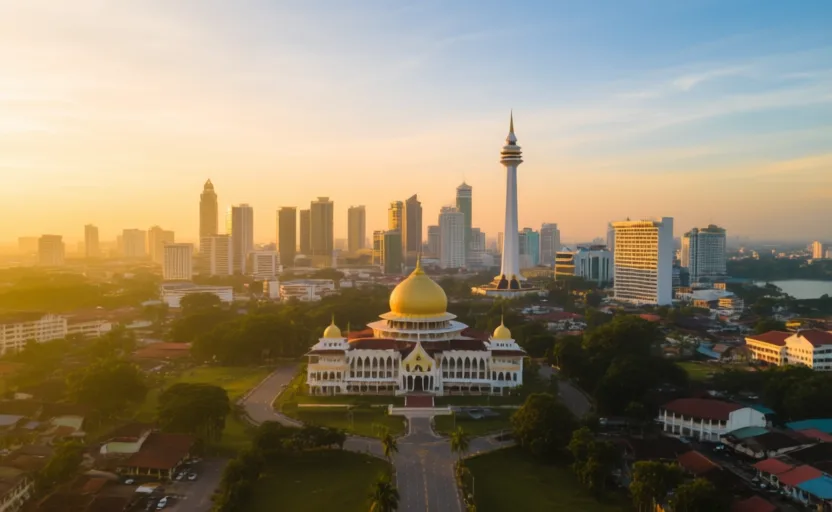 Johor Bahru · AI city illustration · Artistic impression
City · Southeast Asia
Johor Bahru
Saved in this browser — no account needed. Sign in later and it comes with you.
Where it is
The southern tip of the Malay Peninsula ends at the Straits of Johor, a narrow channel, and Johor Bahru is the mainland city on its northern shore, facing Singapore across the water. The land is mostly flat, with a few low hills scattered through the built-up area. The climate is equatorial, with average temperatures between roughly 26 and 28 degrees Celsius all year and about 2,350 millimetres of rain, heaviest during the north-east monsoon from mid-October to January. There is no cyclone season. The strait, and the causeway across it, explain most of what the city has become.
The land and water around it
The Straits of Johorstrait
The channel between the peninsula and Singapore island is the reason the city exists as a border town. A railway, and from 1923 the causeway, tied the two shores together; in January 1942 the British blew a gap in it to slow the Japanese advance, and the invaders repaired it in under a month.
The southern lowlandsplain
Flat, wet ground that was jungle until settlers cleared it. Chinese cultivators grew pepper and gambier here, and Javanese labourers dug the drainage canals that made farming and roads possible. The flat terrain is also why the modern city has spread out so widely and depends so heavily on cars.
An equatorial climateclimate
Temperatures hardly change through the year, so the seasons are marked by wind and rain instead. The north-east monsoon, from mid-October to January, brings the heavier rainfall; the south-west monsoon, from June to September, barely affects the city.
Its history, in short
Before the 1850s this was a Malay fishing village called Tanjung Puteri, on the edge of undeveloped jungle. The Johor-Riau Sultanate split in 1819, and the mainland half passed to the Temenggong, Daeng Ibrahim, who worked closely with the British in Singapore. In 1855 a treaty confirmed his control of the mainland, and he encouraged Chinese settlers to plant pepper and gambier while Javanese labourers dug drainage canals and planted coconuts. His son, Sultan Abu Bakar, renamed the place Johor Bahru, “New Johor”, to distinguish it from the old capital, and between 1886 and 1895 built offices, schools, a palace and a railway towards Singapore. Johor was advised by the British but not directly ruled until 1914. The railway reached the town in 1909 and the causeway opened in 1923. Japanese forces took Johor Bahru in January 1942, and after the war it became the place where Malay nationalism organised. Federation in 1963 kept it as a state capital, city status followed in 1994, and since 2006 the Iskandar Malaysia economic zone has pulled investment and building into the area.
Timeline
Dates are shown on a timeline rather than as changing shapes on the map. The globe draws modern boundaries only, and tinting a modern outline to stand for a historical one would state something we cannot source.
Industrial & imperial
1819
The sultanate divides
A dispute between Malays and Bugis splits the Johor-Riau Sultanate. The mainland part comes under the Temenggong, Daeng Ibrahim, the ruler who later builds a new administrative centre where Johor Bahru now stands.
Well attestedWikipedia10 March 1855
The treaty with Sultan Ali
In Singapore, Sultan Ali cedes sovereignty over Johor, apart from Kesang in Muar, to the Temenggong in return for a payment and a monthly allowance. The Temenggong then renames the territory Iskandar Puteri and governs it from Singapore.
Well attestedWikipedia1886–1895
Sultan Abu Bakar modernises the town
Under Abu Bakar the fishing village gets administrative buildings, offices, schools and a railway line to Woodlands in Singapore. The merchant Wong Ah Fook helps build the state mosque and the royal palace.
Well attestedWikipedia1923
The causeway opens
The Johor-Singapore Causeway is completed, after the peninsula railway extension reached Johor Bahru in 1909. The link makes the city a daily crossing point and later one of the busiest land borders in the world.
Well attestedWikipediaJanuary 1942
Japanese occupation
Japanese forces enter Johor Bahru on 31 January, a day after the British retreat to Singapore and blow up the causeway. The Sultan’s Bukit Serene residence becomes a Japanese base, chosen partly because the British would not bomb it.
Well attestedWikipedia
Contemporary
11 May 1946
UMNO is founded
Onn Jaafar founds the United Malays National Organisation at the Istana Besar, in protest at the citizenship terms proposed for the Malayan Union. An understanding follows in the town on political and economic roles between Malays and non-Malays.
Well attestedWikipedia1 January 1994
City status
Johor Bahru is formally made a city and gets its own city council. The central business district grows around Wong Ah Fook Street from the mid-1990s.
Well attestedWikipedia2006
Iskandar Malaysia
The creation of the Iskandar Malaysia zone brings much more state and federal money into the city, and a run of high-rise apartment and commercial building follows.
Well attestedWikipedia
Places that carry meaning
Istana Besar (the Grand Palace)19th century onward
A Victorian-style palace in a garden, which now houses the Royal Abu Bakar Museum. It is also where UMNO was formed in 1946, so it matters to Malaysian political history as well as to the royal house of Johor.
Johor-Singapore Causeway1923
The crossing that makes Johor Bahru a border city. Rail, road and, in future, the planned RTS Link all run towards Singapore, and the city is described as having the busiest land border crossing in the world.
Wong Ah Fook Street and the old centreLate 19th century onward
The street is named after the Chinese businessman and pepper and gambier cultivator who became a patron of Sultan Abu Bakar and helped build the mosque and the palace. The modern central business district grew up around it.
Sultan Ibrahim Building1940
The state secretariat, finished as the British tried to streamline Johor’s administration, in the years when Johor was advised by a British officer without being a formal colony.
Languages here
Places are usually multilingual. This lists what is actually spoken, not one language per border.
MalayAustronesian family
The language of the Malay majority and of the state.
Johor Bahru’s Malays have close ties with the Riau Malays across the water in Indonesia, and the community includes many with Javanese, Bugis and Banjarese ancestry.
Mandarin and Chinese varietiesSino-Tibetan family
Mandarin is the main language of the Chinese community, which also keeps older dialects.
Most local Chinese descend from Hokkien and Teochew speakers, with smaller Hakka, Cantonese, Henghua, Foochow and Hainanese groups. Each Chinese dialect group has a place in the annual Chingay parade by the Old Chinese Temple.
TamilDravidian family
The main language of the Indian community.
Tamil dominates, with smaller numbers of Malayalam, Telugu and Punjabi speakers. The city’s oldest cinema, the Broadway Theatre, mostly showed Tamil and Hindi films.
EnglishGermanic family
A common second language, especially among younger people.
About 60 per cent of residents are fluent in English, with a higher share among the young, which is useful for a city that lives off a border with Singapore.
Learn the language here
- 1Understand which languages are spoken hereJohor Bahru is multilingual. Start with which languages are used, by whom, and for what — the phrase list only covers one of them.Written by Globe Quest
- 2Learn 11 phrasesCurated everyday phrases for Johor Bahru, with audio and a written form.Written by Globe Quest
- 3Say them out loudSpeaking practice with pronunciation feedback, one phrase at a time.Globe Quest material, your own additions
- 4Come back to themSpaced review, so what you learned this week is still there next month.Written by Globe Quest
Check yourself
What does “Bahru” in Johor Bahru mean, and why was it used?
“New”, to tell it apart from Johor Lama, Old Johor
Sultan Abu Bakar renamed the town Johor Bahru, “New Johor”, after the Temenggong’s death, to distinguish it from the older capital, Johor Lama.
What happened at the Istana Besar on 11 May 1946?
UMNO was founded there, in response to the Malayan Union’s citizenship rules
Onn Jaafar founded the United Malays National Organisation after Malays objected to the citizenship rules proposed for the Malayan Union, which made Johor Bahru a centre of Malay nationalism.
Worth arguing about
- A city whose economy depends on a land border with a much richer neighbour: what does that do to its sense of being its own place?
- Johor was advised by the British but never ruled as a colony until 1914. How much did that leave of its own political character?
What we have not established
These are open questions, listed rather than filled in. We would rather show a gap than a plausible guess.
How many people live in Johor Bahru?
The 2020 census puts the city proper at about 858,000, while the wider district, which includes Iskandar Puteri and Pasir Gudang, holds about 1.8 million. Which figure people mean depends on where the city boundary is drawn.
Sources
- Wikipedia · Johor BahruWikipedia · encyclopedia · checked 2026-11-24
Reviewed by Globe Quest editorial on 2026-11-24. Drafted with AI assistance and checked against the sources above before publication.