 Globe Quest
 Human Quest · LearningSign in
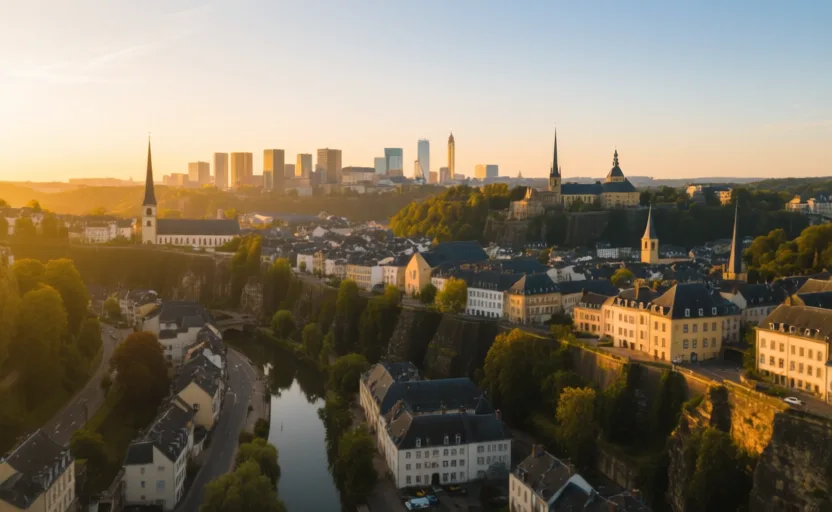 Luxembourg City · AI city illustration · Artistic impression
City · Europe
Luxembourg City
Saved in this browser — no account needed. Sign in later and it comes with you.
Where it is
The centre of Luxembourg City is a rocky spur cut off on three sides by deep, narrow river valleys. It stands at the meeting of the Alzette and the Pétrusse in the south of the country, on a plateau of Early Jurassic sandstone. The rivers have carved gorges about 70 metres deep, so the city is built on several levels, with old quarters at the water's edge far below the upper town, and bridges and viaducts that cross the gaps. The commune covers just over 51 square kilometres, much of it parks, woods and farmland, and the oceanic climate is cool, wet and cloudy for about two thirds of the year.
The land and water around it
The Alzette and Pétrusse gorgescanyon
Two rivers meet at the foot of the old town and have cut valleys about 70 metres deep. Bridges and viaducts such as the Adolphe Bridge and the Passerelle span the drop, and the lower quarters of Grund and Pfaffenthal lie beside the water.
The Bock promontoryplateau
The spur of rock on which the first castle was built. Its cliffs gave the site a natural defence on most sides, so that, in the words of UNESCO's summary, only the western approach needed to be fortified.
The Luxembourg Plateauplateau
The city lies on the southern part of this large sandstone formation, the core of the Guttland, the low and flat southern part of the country.
Its history, in short
The city began as a small castle on a nearly unassailable rock, acquired in 963 by Siegfried of the Ardennes, and the market that grew beside a Roman road crossing below it became the town. Its position made it a fortress for most of its existence. Under Burgundian, Spanish, French, Austrian and Prussian rulers in turn, the defences were thickened and extended until Luxembourg ranked among the strongest places in Europe, honeycombed with tunnels known as casemates. When the 1867 Treaty of London required the fortifications to be taken down, it freed a city that had been pinned inside its walls. Taking it apart was a job of sixteen years. A large share of the modern city was added in 1920 and 1921, when neighbouring communes were merged into it. Since 1952, when the first European coal and steel authority set up here, it has hosted European institutions, and today foreign nationals make up a clear majority of its residents.
Timeline
Dates are shown on a timeline rather than as changing shapes on the map. The globe draws modern boundaries only, and tinting a modern outline to stand for a historical one would state something we cannot source.
Post-classical world
963
The castle on the rock
Siegfried I of the Ardennes acquires the small fortification Lucilinburhuc in an exchange with the abbey of Saint Maximin in Trier, and begins building a stronger castle on the Bock rock.
Well attestedWikipedia1244
A city charter
Countess Ermesinde grants the town its charter. By then it had grown westward around the church that is now the cathedral, and had a new wall around about five hectares.
Well attestedWikipedia1443
Burgundian conquest
Philip the Good's troops take the city, and through inheritance it passes into the Habsburg world. Over the next centuries the fortress was strengthened and fought over by Burgundians, Spanish, French, Austrians and Prussians.
Early modern & oceanic
11 June 1554
Lightning and gunpowder
During a storm lightning strikes a convent church whose attic held gunpowder. The blast and the fire it started destroyed a large part of the upper town, and the plan for a grand new square was only realised in 1671 as the Place d'Armes.
Well attestedWikipediaFrom 1644
The casemates
Spain starts digging 23 kilometres of tunnels into the rock under the fortifications. These galleries are among the best-known remains of the old fortress.
Well attestedWikipedia
Industrial & imperial
1867
The fortress is ordered dismantled
The Treaty of London, after the Luxembourg Crisis, requires the demolition of the fortifications. The work lasted sixteen years, at a cost of 1.5 million gold francs, and it destroyed over 24 kilometres of underground defences, while the Prussian garrison was to withdraw.
1920–1921
Four communes merge
Eich, Hamm, Hollerich and Rollingergrund are absorbed. The city's area rises from 3.55 to 51.52 square kilometres.
Well attestedWikipedia
Contemporary
1952
A European headquarters
The headquarters of the European Coal and Steel Community's High Authority opens in the city. Its seat was later merged away, but the city kept hosting European bodies, most of them now in the Kirchberg quarter.
Well attestedWikipedia
Places that carry meaning
The old quarters and fortifications10th–19th centuries
UNESCO lists the old town and its remaining gates, forts, bastions and casemates, together with the street layout and public buildings that show how the city developed from the 10th century. It calls the fortress the “Gibraltar of the North” in its Austrian phase.
Grund and Neumünster AbbeyMedieval onward
The river-level quarter below the upper town, where people lived and worked at the foot of the ramparts. The old abbey of Neumünster is its landmark.
Kirchberg20th century onward
The north-eastern quarter that houses most European institutions in the city, among them the Court of Justice of the European Union and the European Investment Bank.
Languages here
Places are usually multilingual. This lists what is actually spoken, not one language per border.
LuxembourgishGermanic family
The national language and the everyday language of Luxembourgers.
Luxembourgish is a Moselle Franconian dialect of the West Central German group, mutually intelligible across the border with neighbouring German dialects but with over 5,000 French-origin words. Knowledge of it is required for naturalisation.
FrenchRomance family
The language of legislation and one of three administrative languages.
Under the 1984 Language Regimen Act, French is the only language in which laws are written, and administration must reply in whichever of the three languages the citizen used.
GermanGermanic family
The third administrative language.
German is used in administration and the courts alongside French and Luxembourgish, and the country's culture and languages are shaped by both France and Germany.
PortugueseRomance family
The language of the country's largest immigrant community.
Portuguese nationals make up 13.2 per cent of Luxembourg's population, the largest foreign group, followed by French, Italian, Belgian and German nationals. In the capital, foreigners are 69.5 per cent of residents.
Learn the language here
- 1Understand which languages are spoken hereLuxembourg City is multilingual. Start with which languages are used, by whom, and for what — the phrase list only covers one of them.Written by Globe Quest
- 2Learn 11 phrasesCurated everyday phrases for Luxembourg City, with audio and a written form.Written by Globe Quest
- 3Say them out loudSpeaking practice with pronunciation feedback, one phrase at a time.Globe Quest material, your own additions
- 4Come back to themSpaced review, so what you learned this week is still there next month.Written by Globe Quest
Check yourself
What led to the dismantling of Luxembourg's fortifications?
The 1867 Treaty of London after the Luxembourg Crisis
The treaty required the fortress to be demolished and the Prussian garrison to leave. The demolition took sixteen years and freed the city to grow beyond its walls.
What shaped the city's multi-level layout?
Gorges about 70 metres deep cut by the Alzette and Pétrusse
The rivers cut deep, narrow valleys into a sandstone plateau, so the centre sits on a high spur and lower quarters lie far below, linked by bridges and viaducts.
Worth arguing about
- A fortress city was forced to take down its walls and then grew into a European capital. Which parts of a military past should a city keep?
- Foreign nationals are the majority in the capital and nearly half the country. What does it mean for a national language to be the language of a minority in its own capital?
What we have not established
These are open questions, listed rather than filled in. We would rather show a gap than a plausible guess.
What share of the city's population is foreign?
Figures depend on the definition. One count puts foreign nationals at 69.5 per cent, while a 2021 figure puts people born abroad at 72.7 per cent, and the two measure different things, so they should not be compared.
Sources
- Wikipedia · Luxembourg CityWikipedia · encyclopedia · checked 2026-11-24
- Wikipedia · LuxembourgWikipedia · encyclopedia · checked 2026-11-24
- UNESCO · City of Luxembourg: its Old Quarters and FortificationsUNESCO World Heritage Centre · intergovernmental · checked 2026-11-24
Reviewed by Globe Quest editorial on 2026-11-24. Drafted with AI assistance and checked against the sources above before publication.