 Globe Quest
 Human Quest · LearningSign in
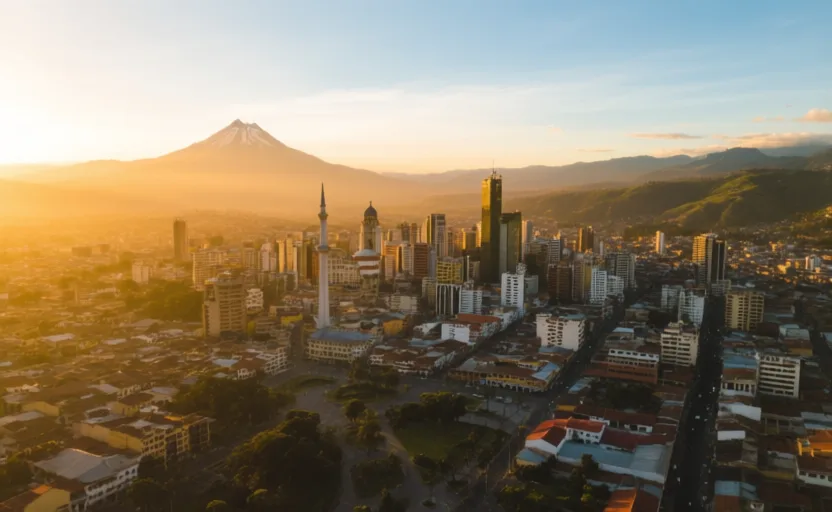 Ambato · AI city illustration · Artistic impression
City · Latin America
Ambato
Saved in this browser — no account needed. Sign in later and it comes with you.
Where it is
Ambato is cut into the side of Cerro Casigana, the hill that closes the north end of the city, in the main valley between Ecuador’s Andean ranges at about 2,577 metres. The Ambato River has carved a deep trench through its northern edge. It is a modest river, but heavy rain can make it flood, and it has made better bridges across it a civic priority. From the streets on a clear day the snow-capped volcanoes Cotopaxi, Carihuairazo and Chimborazo can be seen, and Tungurahua stands about 40 kilometres to the south-east. At this height just south of the Equator the climate is mild all year, with warm afternoons and cool nights.
The land and water around it
The Ambato Riverriver
A narrow river that runs through the north of the city. Over time it has cut a deep basin into the land, and in October 2008 the city opened a long-awaited bridge, named for the writer Juan León Mera, to carry traffic across.
Tungurahua volcanovolcano
About 40 kilometres to the south-east, Tungurahua is an active volcano whose threat is constant. When it erupted on 16 May 2006 a thick layer of ash fell on the city.
The Andean valleyvalley
The city sits in the main valley of the central ranges, among some of the highest peaks in the country, including Chimborazo, the largest mountain in Ecuador.
Its history, in short
Ambato’s history is a series of rebuildings after earthquakes. In June 1698 an earthquake and landslide destroyed the earlier settlement and killed thousands, and in December of that year the town was founded again on higher ground, where it stands today. For a century it grew slowly into an important mountain centre. In the wars of independence the town was among the first liberated by the army raised in Guayaquil in 1820, and it declared its own separation from Spain on 12 November that year. But royalist forces beat the patriots at the two Battles of Huachi, on its edge, in 1820 and 1821, before Sucre finally prevailed. In the early republic Ambato was a cultural and economic centre that produced thinkers and writers, and constitutions were drafted here. On 5 August 1949 a new earthquake almost destroyed the city and its cathedral, killing an estimated 6,000 people. The city was rebuilt over the next years with government and international help, and the new cathedral opened in December 1954.
Timeline
Dates are shown on a timeline rather than as changing shapes on the map. The globe draws modern boundaries only, and tinting a modern outline to stand for a historical one would state something we cannot source.
Early modern & oceanic
20 June 1698
Earthquake and landslide
The former settlement of Ambato was destroyed and thousands were killed. The survivors moved to higher ground.
Well attestedWikipedia6 December 1698
Refounded at its present site
The town was founded at its current location after its inhabitants petitioned the Royal Audience of Quito.
Well attestedWikipedia
Industrial & imperial
12 November 1820
Independence declared
Ambato formally declared separation from Spain after being liberated by the army raised in Guayaquil. Ten days later that army lost the First Battle of Huachi, just outside the town.
Well attestedWikipedia12 September 1821
Second Battle of Huachi
Antonio José de Sucre was defeated on the plains south-east of downtown, now a neighbourhood of the city, and withdrew to Guayaquil.
Well attestedWikipedia
Contemporary
5 August 1949
Earthquake destroys the city
More than 6,000 people died and thousands more lost their homes. Much of the colonial centre, including the cathedral, was ruined.
Approximate dateWikipedia12 December 1954
The new cathedral
A modernist cathedral was inaugurated as the rebuilt city took shape.
Well attestedWikipedia16 May 2006
Ash from Tungurahua
An eruption of the volcano covered the city in a thick layer of ash.
Well attestedWikipedia
Places that carry meaning
The modernist cathedralOpened 1954
Built after the 1949 earthquake destroyed the earlier cathedral, which many had counted among the finest in the country. Its modern design is a mark of the rebuilt city.
The Mera houseHistoric house
The house of Juan León Mera, author of the national anthem, one of the three famous Juans born here. It is among the few attractions in a city better known for industry.
The Monday marketWeekly
A weekly market that fills the streets with food and clothing stalls and draws both locals and visitors from nearby towns.
Languages here
Places are usually multilingual. This lists what is actually spoken, not one language per border.
SpanishRomance family
The everyday and official language.
About 93 per cent of Ecuadorians speak Spanish as a first language.
Kichwa (Quechua)Quechuan family
The Indigenous language of the Andes, and the source of the city’s Quechua name.
The Quechua name of the city is Ampatu Llaqta. Ecuador recognises 13 native languages, Quechua among them, and the highlands are where they are spoken most.
Learn the language here
- 1Understand which languages are spoken hereAmbato is multilingual. Start with which languages are used, by whom, and for what — the phrase list only covers one of them.Written by Globe Quest
- 2Learn 12 phrasesCurated everyday phrases for Ambato, with audio and a written form.Written by Globe Quest
- 3Say them out loudSpeaking practice with pronunciation feedback, one phrase at a time.Globe Quest material, your own additions
- 4Come back to themSpaced review, so what you learned this week is still there next month.Written by Globe Quest
Check yourself
Why is Ambato called the “Land of the Three Juans”?
Three notable Ecuadorians named Juan were born here
The city was the birthplace of the essayist Juan Montalvo, Juan León Mera, who wrote the national anthem, and the independence figure Juan Benigno Vela.
What happened in Ambato on 5 August 1949?
An earthquake destroyed most of the city
More than 6,000 people died. The city was rebuilt over the next two years, and its Festival of Fruits and Flowers honours the tenacity of the residents who came through it.
Worth arguing about
- Ambato has been rebuilt after earthquakes more than once. Should a city be moved, or rebuilt where it was, when the ground keeps failing?
- A city whose carnival celebrates fruit and flowers is also an industrial centre for bus bodies and leather. How do festival identity and daily economy fit together?
What we have not established
These are open questions, listed rather than filled in. We would rather show a gap than a plausible guess.
How many people live in Ambato?
Figures diverge by definition: about 177,000 for the city proper on one count in 2022, and about 387,000 on another count that appears to cover the wider urban area. The boundary used changes the answer.
Sources
- Wikipedia · Ambato, EcuadorWikipedia · encyclopedia · checked 2026-11-24
- Wikipedia · EcuadorWikipedia · encyclopedia · checked 2026-11-24
Reviewed by Globe Quest editorial on 2026-11-24. Drafted with AI assistance and checked against the sources above before publication.