 Globe Quest
 Human Quest · LearningSign in
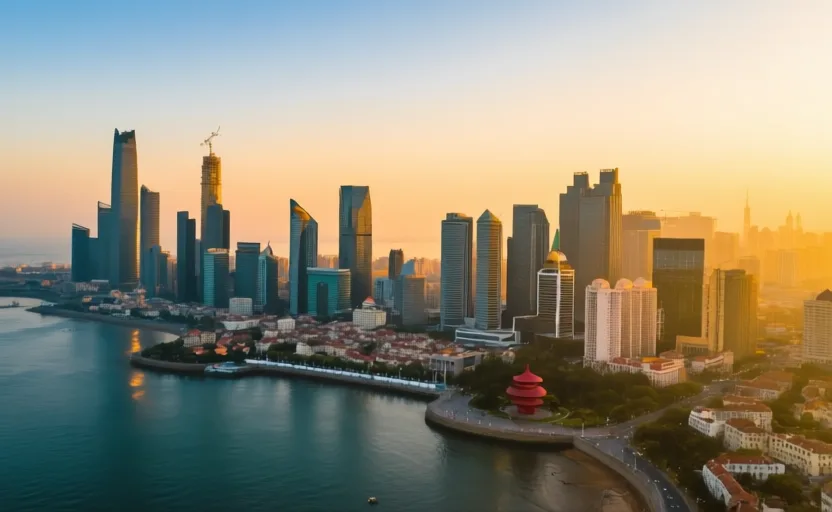 Qingdao · AI city illustration · Artistic impression
City · East Asia
Qingdao
Saved in this browser — no account needed. Sign in later and it comes with you.
Where it is
Qingdao faces south across Jiaozhou Bay on the Shandong Peninsula, with the Yellow Sea on one side and low mountains behind it. The municipality is large, about 10,650 square kilometres, with a coastline of roughly 730 kilometres; the built-up core is flat, but ranges rise inside the city limits, topping out at 1,133 metres. The sea moderates the climate. Spring arrives about a month later than inland, winters are cool and dry, and summer heat is tempered, which is why the coast became a holiday resort. The same warm shallow water breeds algal blooms that foul the beaches in summer.
The land and water around it
Jiaozhou Baybay
The sheltered bay on the south coast of the peninsula is the reason the place was fortified and then ceded. A bridge now links the old urban area to Huangdao district on the far shore.
Shandong Peninsula coastcoast
The municipality has about 730 kilometres of shoreline facing the Yellow Sea. Water temperature peaks near 25 °C in late August, and the sea keeps annual temperature swings small.
Mount Laomountains
A mountain district about 40 kilometres east of the centre, long known as a Taoist mountain. Hills like it are part of why only about 38 per cent of the municipality is plain.
Its history, in short
Neolithic farmers lived on this coast long before any port existed, and digs across the municipality have found graves and house sites of several early cultures. The city as it is known today is far younger. The Qing began fortifying a small settlement called Jiao’ao in 1891, but in 1897 Germany used the killing of two missionaries as grounds to seize the fortification, and in 1898 the Qing conceded the bay as a leased territory. The Germans built the wharves, the railway to Jinan and the street plan, and the brewery followed in 1903. Japan took the city in 1914 and kept it through the Paris settlement, an outcome that helped set off the May Fourth Movement. Chinese rule returned in 1922. Japan occupied it again from 1938 until 1945, and the Communist army entered in 1949. Since the open-door policy of 1984 Qingdao has grown into a major container port, a naval headquarters and a base for appliance and electronics makers.
Timeline
Dates are shown on a timeline rather than as changing shapes on the map. The globe draws modern boundaries only, and tinting a modern outline to stand for a historical one would state something we cannot source.
First cities & states
c. 5400–4400 BCE
First farmers
Sites of the Beixin culture, such as Nanguojia in Pingdu, are the oldest farming settlements found in the area. Later Dawenkou, Longshan and Yueshi remains are scattered across the city.
Approximate dateWikipedia
Industrial & imperial
1891
Qing fortification
The Qing decide to fortify Jiao’ao as a defence against attack from the sea.
Well attestedWikipedia1898–1914
German leased territory
After the Juye Incident of 1897, German troops occupy the fort and the Qing concede the bay. The concession covers 552 square kilometres. Wharves, a railway, schools and a street plan turn a fishing coast into a port city.
Well attestedWikipedia1914
Siege and Japanese occupation
Japan declares war on Germany under the Anglo-Japanese Alliance and takes the city. China protests but cannot intervene.
Well attestedWikipedia4 May 1919
May Fourth Movement
The decision at Paris not to restore Chinese rule in Qingdao sets off a nationwide protest movement of anti-imperialism and nationalism.
Well attestedWikipediaDecember 1922
Return to Chinese rule
The city comes under the Republic of China. By 1937 it has about 385,000 residents and a reputation as a summer retreat.
Well attestedWikipedia
Contemporary
2 June 1949
People’s Republic
Communist forces enter the city, which has been under PRC control since.
Well attestedWikipedia1984
Open-door policy
Opening to foreign trade and investment starts a rapid rise. In November three US Navy ships make the first American port call in China in over 37 years.
Well attestedWikipedia
Places that carry meaning
The old German quarter1898–1914
Western Shinan district keeps many German-style buildings, remarkable for a leased territory that lasted only sixteen years. Red tile roofs against trees and sea gave the city its old saying.
Tsingtao Brewery1903
Founded by a German-British joint venture, it is the second-largest brewery in China and the best-known survivor of the German period. An international beer festival has run every late summer since 1991.
Zhan Qiao pierColonial era onward
A pier on the western shore of Shinan district, with Little Qingdao Isle just offshore. The German names for the two were Tsingtau Brücke and Arcona Insel.
Languages here
Places are usually multilingual. This lists what is actually spoken, not one language per border.
Mandarin ChineseSino-Tibetan family
The official language, spoken alongside the local dialect.
City authorities have promoted standard Mandarin, and most educated residents speak it as well as their native speech. A local Qingdao accent marks residents out from the rest of Shandong.
GermanGermanic family
The official language of the leased territory, now nearly gone.
Taught rigorously between 1898 and 1914, it left little mark on local speech after the German empire’s colonies ended.
KoreanKoreanic family
Spoken by a large expatriate community.
About 100,000 Koreans lived, worked and studied here by 2009, making the city second only to Beijing for Koreans in China.
Learn the language here
- 1Understand which languages are spoken hereQingdao is multilingual. Start with which languages are used, by whom, and for what — the phrase list only covers one of them.Written by Globe Quest
- 2Learn 11 phrasesCurated everyday phrases for Qingdao, with audio and a written form.Written by Globe Quest
- 3Say them out loudSpeaking practice with pronunciation feedback, one phrase at a time.Globe Quest material, your own additions
- 4Come back to themSpaced review, so what you learned this week is still there next month.Written by Globe Quest
Check yourself
How long did the German leased territory at Qingdao last?
About sixteen years
The concession ran from 1898 to 1914, ending when Japan took the city in the First World War, yet its architecture and brewery still shape the centre.
What did the Paris decision on Qingdao set off?
The May Fourth Movement
Refusing to restore Chinese rule over former German holdings, including Qingdao, provoked the 1919 protest movement of anti-imperialism and nationalism.
Worth arguing about
- A concession lasting sixteen years left a street plan, a brewery and a skyline of red roofs. What makes some short occupations so durable in a city’s form?
- The warm coastal water that makes Qingdao a beach resort also feeds summer algal blooms. How should a seaside city weigh its sea trade against its seaside image?
What we have not established
These are open questions, listed rather than filled in. We would rather show a gap than a plausible guess.
How many people live in Qingdao?
About 7.2 million lived in the seven urban districts at the 2020 census, and about 10.1 million in the whole municipality. Which figure is meant depends on the boundary used.
Sources
- Wikipedia · QingdaoWikipedia · encyclopedia · checked 2026-11-24
Reviewed by Globe Quest editorial on 2026-11-24. Drafted with AI assistance and checked against the sources above before publication.